Corporate vehicles in Norway

Corporate vehicles in Norway

This guide provides an introduction to the main corporate vehicles available to foreign investors when starting a business in Norway. The guide is not exhaustive and focuses on private limited liability companies and branch offices, the two corporate vehicles most commonly used by foreign investors.

This article is part of our Doing Business in Norway guide.

Choosing the right type of corporate vehicle for your investment

Choosing the correct corporate vehicle to conduct your business is the most important decision you make as an investor and this choice affects:

  • How much personal risk you have (liability)
  • How you pay taxes
  • What rules you must follow (regulatory obligations)
  • How the business is managed (governance)
  • How easy it is to bring in new investors or sell the business later

Overview of corporate vehicles available to foreign investors

Sole proprietorship (“Enkeltpersonforetak” or “ENK”)
  • Owned and operated by one person.
  • The business is not a separate legal entity, so the sole owner is personally responsible for all debts and obligations attaching to the business.
  • The owner cannot be an employee of their own business and thus, social security rights are more limited for the owner than for regular employees.
Co-operatives (“Samvirkeforetak” or “SA”)
  • Owned and run by its members for their shared financial benefit.
  • The main goal is to support the members’ economic interests, not make any profit to outside investors.
  • There is no minimum capital requirement, but the co-operative must always have enough equity to be financially sound. Profits can be shared among the members based on how much they use the co-operative and not just based on how much money they invested.
  • Usually, co-operatives cannot be bought by outside investors.
General partnerships (“Ansvarlig selskap” or “ANS/DA”)
  • Owned by two or more people and/or companies, known as “partners”.
  • All partners are personally responsible for the business’ debts.
  • In an ANS, all partners share responsibility for all debts (joint and several liability).
  • In a DA, each partner is only responsible for a set share of the debts.
  • There is no minimum capital requirement, but creditors can demand payment directly from the partners.
Norwegian branch of a foreign company (“Norskregistrert utenlandsk foretak” or “NUF”)
  • A NUF is a branch of a foreign company operating in Norway and is not a separate legal entity, so the foreign company remains liable for all its Norwegian obligations.
  • If a foreign company does business in Norway, it must usually register in the Norwegian Register of Business Enterprises (Nw. “Foretaksregisteret”).
  • If the branch only needs a Norwegian organisation number and does not do business, it can register in the Central Coordinating Register for Legal Entities (Nw. “Enhetsregisteret”).
  • The branch must have a contact person in Norway with a Norwegian ID number or D-number.
  • NUFs are often used for single projects or when the Norwegian activity is just an extension of the foreign company.
Joint ventures (“JV”)
  • Especially common in the oil and gas industry in Norway and international research projects.
  • Usually set up as a separate company (often an AS or a general partnership) or as a contract between companies and/or organisations and/or people.
  • If not a separate company, the partners may still be personally responsible for its debts.
  • Norwegian law has no dedicated “joint venture company” vehicle and the JV is governed and regulated by the parties’ JV contract.
Limited liability companies (“Aksjeselskap” or “AS” and “Allmennaksjeselskap” or “ASA”)
  • Both are separate legal entities. The legal default position is that the shareholders’ liability is limited to their investment, and their personal assets are protected. However, in exceptional cases (e.g. severe misuse, significant undercapitalisation, or commingling of personal and corporate assets) the courts may decide to pierce the corporate veil to hold shareholders or directors personally liable.
  • An ASA is designed for many shareholders and can be listed on a stock exchange. An AS cannot be listed.
  • The minimum share capital is NOK 30,000 for an AS and NOK 1,000,000 for an ASA.
  • The AS is regulated by the Norwegian Private Limited Liability Companies Act (Nw. “aksjeloven”), and the ASA is regulated by the Public Limited Liability Companies Act (Nw. “allmennaksjeloven”).

Key features – AS

  • The AS is a separate legal entity and the most commonly chosen structure for new businesses.
  • Minimum Share Capital: At least NOK 30,000 is required to start.
  • Shareholders: Can have one or more owners.
  • Management: Must have a board of directors consisting of at least one member. Must hold at least one general meeting per annum. Not required to appoint a general manger/CEO (if share capital below NOK three million).
  • Regulation: Governed by the Norwegian Private Limited Liability Companies Act (Nw. “aksjeloven”).

Key features – ASA

  • The ASA is designed for larger companies and may be listed on a stock exchange.
  • Minimum Share Capital: At least NOK 1,000,000 is required to start.
  • Shareholders: Can have one or more owners.
  • Management: Must have a board of directors with at least three members. Must hold at least one general meeting per annum. An ASA must always appoint a managing director (unlike an AS with share capital below NOK three million).
  • Regulation: Governed by the Public Limited Liability Companies Act (Nw. “allmennaksjeloven”).

Next steps

We regularly assist foreign investors with all legal steps required to register and operate businesses in Norway, including opening bank accounts, hiring employees, tax registration, IP registration, GDPR compliance and contract negotiations.

Contact us today for an informal chat on how to get started.

Last updated: 29 June 2026

Registration and incorporation in Norway

Registration and incorporation in Norway

In this guide you can get a brief overview on how to register and incorporate a business in Norway, including key legal requirements of incorporation, share capital requirements and rules of registration.

This article is part of our Doing Business in Norway guide.

Introduction

Foreign companies that carry out commercial activity in Norway or on the Norwegian continental shelf are required to register in the Norwegian Register of Business Enterprises (Nw. “Foretaksregisteret”, “NRBE”). Upon registration, those companies are ordinarily also registered in the Central Coordinating Register for Legal Entities (Nw. “Enhetsregisteret“) and assigned a Norwegian organisation number.

Enterprises without commercial activity in Norway that nonetheless require a Norwegian organisation number, e.g. because they are registered as employers, may register voluntarily in the Central Coordinating Register for Legal Entities.

Norway operates a largely digital registration regime, and foreign investors can generally complete the incorporation process remotely. A private limited liability company (“AS”) may be incorporated by one or more investors, individuals or legal entities, regardless of nationality or domicile.

Minimum costs of formation

The principal formation costs are professional adviser’s fees. Said fees are variable, depending on the complexity of the incorporation and whether the share capital is to be contributed in cash or in kind. Additional costs may arise for founding documents, bank account opening and ancillary regulatory registrations.

Filing obligation and pre-registration liability

Companies with a mandatory registration obligation must submit their application for first-time registration to the NRBE before commencing any business activity. As a general rule, an AS cannot freely acquire rights or incur obligations vis-à-vis third parties before it is registered in NRBE.

For public limited liability companies (Nw. “allmennaksjeselskap”, “ASA”) the law provides that, before registration, the company may only incur obligations arising from the incorporation documents or by operation of law. Transactions entered into on behalf of an unregistered ASA should be kept to a minimum.

Three-month notification deadline

Any AS, ASA or co-operative (Nw. “samvirkeforetak”) must be notified to the NRBE within three months of the date on which the founders sign the memorandum of association (Nw. “stiftelsesdokument”). Failure to meet this deadline may require the incorporation process to be restarted.

Statutory processing times

The NRBE is subject to the following statutory processing periods for first-time registrations:

  • Five working days: where the company is incorporated electronically using the standard template approved by NRBE.
  • Ten working days: for all other first-time registrations.

If these periods cannot be met, NRBE must notify the applicant.

D-number applications and certificate of incorporation

Where one or more founders or board members is a foreign national without a Norwegian national identity number, a D-number application must be submitted in conjunction with the registration application and the overall process may then take up to four weeks. Upon successful registration, NRBE will issue a certificate of incorporation (Nw. “firmaattest“) confirming the company’s registration as a separate legal entity with its own organisation number.

Step-by-step guide to incorporating an AS in Norway

Alternative: SPV or shelf company

Please see for more information on the process involved in acquiring an SPV and/or a shelf company pursuant to Norwegian law.

Bank account

Norwegian law requires every Norwegian company to hold a Norwegian bank account and when opening one, banks will typically require the following:

  • A certificate of incorporation or, for companies in the process of incorporation, the signed memorandum of association and articles of association
  • Identification details for all shareholders holding more than 25% of the shares or voting rights (including full name, address, and national identity number or foreign equivalent)
  • Key financial figures and a brief description of the company’s planned business activities
  • Identity documents for authorised signatories and beneficial owners in compliance with the bank’s know-your-customer (“KYC”) and anti-money laundering (“AML”) obligations

Norwegian banks’ KYC and AML procedures can be time-consuming, particularly for foreign-owned companies, and it is advisable to initiate this process as early as possible.

Next Steps

We regularly assist foreign investors with all legal steps to register and operate businesses in Norway, including incorporation of Norwegian companies, opening bank accounts, hiring employees, tax registration, intellectual property registration, GDPR compliance and contract negotiations.
 
Please contact us today for an informal discussion on how we can assist you in getting started.

Last updated: 29 June 2026

Special purpose vehicle or shelf company in Norway

Special purpose vehicle or shelf company in Norway

In this guide, you’ll be provided with an overview of the process of acquiring a special purpose vehicle (“SPV“) or a shelf company and how this method differs from a fresh incorporation.

This article is part of our Doing Business in Norway guide.

Introduction

Incorporating a new Norwegian private limited liability company (“AS”) is the most common route to market for foreign investors, but it is not the only one. In certain circumstances, purchasing an existing company in the form of a SPV or a shelf company may offer a faster and more commercially efficient alternative.

This simplified guide sets out some key considerations for foreign investors considering acquisitions of SPVs and/or shelf companies in Norway.

What is an SPV?

An SPV is a company incorporated for a defined and limited purpose, typically to ring-fence a specific asset, transaction or liability from the broader group. In Norwegian corporate practice, an SPV is most commonly structured as an AS, and is characterised by the following:

  • It is a separate legal entity with its own organisation number and limited liability.
  • It typically has no employees, no independent administration and conducts no commercial activity of its own: it exists solely to hold an asset or fulfil a specific function.
  • It is 100% owned by a parent company or holding structure, which retains full control.

This structure is widely used across Norwegian industry, including real estate, oil and gas, shipping and project finance.

What is a shelf company?

A shelf company is a fully incorporated AS that has been registered in the Norwegian Register of Business Enterprises (Nw. “Foretaksregisteret”, “NRBE”) but has never traded. It has been incorporated, assigned an organisation number and placed “on the shelf” and is ready for immediate use by a purchaser.
 
The key commercial advantage of a shelf company over a fresh incorporation is speed, because the company already exists as a registered legal entity, a purchaser can begin operating under an established Norwegian company immediately upon completion of the share transfer, without waiting for the statutory processing time of five to ten working days that applies to first-time registrations.

Key considerations

Both an SPV and a shelf company structured as an AS are separate legal entities under the Norwegian Private Limited Liability Companies Act (Nw “aksjeloven”).

2. Minimum share capital

The minimum share capital for an AS is NOK 30 000,- paid up in full prior to registration. When acquiring a shelf company or SPV, the purchaser should confirm that the share capital has been duly paid and that the company’s equity position meets its ongoing statutory requirements.

3. Transfer of shares

The acquisition of an SPV or shelf company is done by way of a share transfer. The purchaser acquires the existing shares in the company rather than its underlying assets. The transfer must comply with any consent requirements or pre-emption rights set out in the company’s articles of association (Nw “vedtekter”) and any shareholders’ agreement in place.

4. Due diligence

Unlike a fresh incorporation, the acquisition of an existing company carries some inherited legal risk, since the purchaser acquires the company together with all of its historic obligations, liabilities and tax positions. The risk is limited in a company that has never traded, but your advisors will consider whether it is appropriate to conduct a simplified legal and tax due diligence prior to completion. This assessment will be on a case-by-case basis.

5. Post-acquisition registrations

Following the share transfer, a number of practical steps will typically be required, including:

  • Updating the NRBE to reflect the new ownership and board composition.
  • Updating the company’s bank mandate and signatory authority.
  • Registering for VAT (mandatory once taxable turnover exceeds the applicable threshold within a twelve-month period) and as an employer, where applicable.
  • Filing a notification with the NRBE of any changes to the articles of association.

Next Steps

At Brækhus, we assist clients across the full lifecycle of an SPV or shelf company acquisition — from identifying a suitable vehicle and conducting legal due diligence, to negotiating and drafting the share purchase agreement, managing post-completion registrations and providing ongoing corporate governance support.
 
Our team has in-depth expertise in Norwegian corporate law and regularly advises foreign investors, international groups and financial institutions on Norwegian corporate structures, including SPV acquisitions in the real estate and technology sectors.
 
If you are considering purchasing an SPV or shelf company as an alternative to incorporating a new AS, we would be pleased to discuss your specific business needs and advise on the most appropriate structure.

Contact us today for an informal discussion.

Last updated: 29 June 2026

Board member duties in Norway

Board member duties in Norway

In this guide, you will learn about the legal duties and responsibilities of board members in Norwegian private limited companies during ordinary operation, including governance obligations, financial oversight and control obligations, as well as a brief introduction to board member’s duties to shareholders.

This article is part of our Doing Business in Norway guide.

Introduction

When a private limited liability company (Nw. “aksjeselskap”, “AS”) is established, the board of directors (“Board”) assumes a broad and dynamic responsibility that endures throughout the entire life of the company from incorporation through to any critical phases that may arise.

The Board’s duties extend beyond mere compliance with legislation and regulations; they encompass active management, ensuring sound operations, and taking the necessary steps when challenges emerge. A well-functioning board is critical to the company’s success.

This article examines what the Board actually does in practice and their duties pursuant to Norwegian law.

The Board’s duties

The board’s duties in an AS are governed principally by the Norwegian Private Limited Liability Companies Act (Nw. “aksjeloven”, “NPLLCA), the company’s articles of association (Nw. “vedtekter”), and any board instructions issued by the general meeting.
 
In addition, the Board must at all times promote the interests of the company, this is a concept commonly referred to as the “company interest” (Nw. “selskapsinteressen”) in Norway. This means that the Board must act in the best interests of the company as an independent legal entity, in accordance with law, the articles of association and lawful resolutions passed by the general meeting. The shareholders’ economic interests will ordinarily be an important consideration, but the company interest is not always identical to the shareholders’ interests. In each individual case, the Board must carry out a broad and balanced assessment in which the interests of creditors, employees, key counterparties and others are given appropriate weight.
 
The tension between company interest and shareholder interest is a classic debate in corporate governance, specifically, how a board should protect the company’s interests where shareholders seek to place their own interests ahead of the company’s (“shareholder activism”).

The board of directors’ role during ordinary operations

In ordinary circumstances, the Board bears overall responsibility for ensuring that the company is managed soundly and in accordance with the law, the articles of association and the resolutions of the general meeting. This includes:

  • Planning and strategy: The Board must establish plans and budgets for the business and follow up to ensure they are adhered to.
  • Organisation: The Board is responsible for ensuring that the company is soundly organised. This includes ensuring that the day-to-day management and administration have the resources to carry out their tasks and that competent personnel are appointed.
  • Financial oversight: The Board must at all times remain informed of the company’s financial position and ensure that equity and liquidity are maintained. This also involves monitoring accounts, internal controls and reporting procedures.
  • Supervision: The Board must supervise the day-to-day management and the business generally. This includes intervening where tasks are not carried out soundly and the Board may instruct management, reverse decisions and implement necessary changes.
  • Disclosure obligations: The Board must ensure that shareholders and others receive the necessary information about the company.

An appointed CEO (Nw. “daglig leder”) typically plays a central role in day-to-day operations, while the Board functions primarily as a supervisory and strategic body at the overarching level.

Companies without a CEO

Where no CEO has been appointed, the Board assumes responsibility for day-to-day management regardless of its size. Hence, the Board must be particularly attentive and proactive, even in ordinary operating conditions. It is not sufficient to maintain only an overarching overview, the Board must ensure that all day-to-day tasks, obligations and duties are followed, including ongoing financial monitoring, payment of taxes and levies, and contract management. This heightens the supervisory responsibility and requires the Board to be more proactive than in companies that have a CEO.

When problems arise – heightened duties

Where the company encounters financial difficulties, the Board’s duties are intensified and the Board must move to become an active manager, ensuring:

  • Ongoing assessment of the financial position: The Board must continuously assess whether the company’s equity and liquidity remain adequate. Where doubt arises, the board must consider remedial measures.
  • Measures to rectify the situation: The Board must implement measures to improve the financial position, for example by raising new capital, renegotiating loans or reducing costs.
  • Notification and disclosure: The Board must ensure that shareholders and, where relevant, creditors receive the necessary information about the situation.

The weaker the financial position becomes, the more actively the Board must respond and monitoring alone is no longer sufficient.

The Board’s duty to act and duty to file for bankruptcy

Where it is no longer possible to restore the company’s financial position, the Board has a duty to propose dissolution of the company. Where the company is insolvent, that is, where it is unable to meet its payment obligations as they fall due and its liabilities exceed the value of its assets, the Board must file for bankruptcy on behalf of the company. This must be done by the Board as a whole, by way of a valid board resolution, and does not require the approval of the general meeting.

What happens if the Board fails to do its job?

Board members may be held personally liable if they fail to fulfil their duties, particularly in situations where the company is performing poorly and the Board fails to act promptly enough. It is therefore essential that the board has sound reporting procedures in place, meets regularly, and documents its assessments and decisions.

Next steps

Getting Board governance right requires more than good intentions; it requires a clear understanding of the legal framework, sound internal procedures and timely professional advice.
 
We regularly assist boards of directors, shareholders and management teams with corporate governance, financial distress, personal liability risk and general corporate housekeeping. Whether you are a newly appointed board member seeking to understand your obligations, an existing board navigating a period of financial difficulty, or a shareholder concerned about how your company is being managed, we are here to help.
 
Contact us today for an informal chat on how we can assist you.

Last updated: 29 June 2026

The board of directors’ responsibilities in a financial crisis in Norway

The board of directors’ responsibilities in a financial crisis in Norway

In this guide, you will learn about the board of directors’ legal responsibilities during a financial crisis, including duties related to liquidity and equity monitoring, creditor communication, restructuring measures, insolvency assessments, and how personal liability may arise.

This article is part of our Doing Business in Norway guide.

Introduction

When a company faces financial difficulties, the demands placed on the board of directors (“Board”) increase significantly. A Board position carries substantial legal responsibility, one that becomes particularly acute when the company risks losing control of its finances.

Key principles of good corporate governance

  • Monitor finances continuously: track liquidity, revenues, costs and forecasts. Act early; early intervention can be the difference between rescue and insolvency.
  • Act proactively: as soon as equity or liquidity may become inadequate, discuss remedial action. Small adjustments made early can prevent larger problems later.
  • Document everything: written resolutions and minutes for all material decisions. Systematic documentation demonstrates that the Board acted on the information available at the time.
  • Avoid new high-risk obligations: do not incur significant new commitments unless the company can reasonably meet them. Acting recklessly when the company is already struggling can trigger personal liability.
  • Communicate honestly: be open with key stakeholders (banks, key suppliers, employees) about the challenges but also convey that the Board has a plan. Do not conceal material information from contractual counterparts.
  • Comply with the statutory duty to act: if equity becomes inadequate.
  • Ensure implementation or accept the consequences: if owners will not or cannot implement the necessary measures, the Board must consider filing for bankruptcy in good time, or resigning, if prevented from acting soundly.

Ultimately, Board responsibility is real and extensive and in a crisis, it is far better to act early than to face criticism later for passivity.

Heightened responsibility in a crisis

Before a crisis arises, the Board should establish sound routines for financial reporting and oversight. When revenues fall and costs rise, liquidity management becomes critical. The Board must regularly assess whether both liquidity and equity are adequate; it is not sufficient to wait for the annual accounts. Realistic liquidity budgets should be prepared and monitored closely.

In practice, deciding how transparent to be externally is a difficult balancing act. Excessive openness about financial difficulties may alarm suppliers and creditors; withholding material information, however, may give rise to liability. It is particularly dangerous for the company to continue entering into contracts that the Board or management knows are unlikely to be fulfilled. The Board should communicate clearly about uncertainties when new contracts are entered into, without creating unnecessary alarm. The standard of care intensifies as the situation becomes more acute, because creditor and employee losses mount, and the law requires proactive action to avert insolvency.

Core duty: Sound equity and liquidity

The Board has a statutory obligation to ensure that the company at all times maintains equity and liquidity that is adequate given the risk and scale of the business. The Board must continuously monitor the company’s financial position. Where doubt arises as to whether the company’s capital is sufficient, the Board must act immediately.

If the Board concludes that equity is no longer adequate, or has been lost entirely, the statutory duty to act is triggered. The Board must promptly address the matter and convene a general meeting. At the general meeting, the Board must present a statement of the company’s financial position and propose measures to restore adequate equity. Typical measures include injecting new capital (for example, through a share issue or a subordinated loan from the owners) or reducing costs and liabilities (selling assets, discontinuing loss-making activities). If the Board cannot identify any realistic remedial measures, the law requires it to propose dissolution.

The general meeting is formally free to decide how to respond to the Board’s proposals. If the owners choose not to implement the necessary measures, the Board has discharged its duty by giving notice and proposing solutions. Board members who remain in office without being able to act soundly risk personal liability. Where insolvency is a fact, the Board must file for bankruptcy, or individual board members should consider resigning.

Board work and documentation in a crisis

It is essential that all decisions are carefully documented. Detailed board minutes can serve as critical evidence that the Board acted soundly and in a timely manner. If creditors or others later challenge the Board’s actions, minutes, written assessments and recorded decisions will be the Board’s best defence. All communication on material decisions within the board and between the Board and the owners should be made or confirmed in writing. Where necessary, the Board should engage external advisers, including auditors, accountants or lawyers.

Measures that may secure continued operations (alternatives to bankruptcy)

When a company faces serious financial difficulties, the Board should explore all available options to avoid bankruptcy. Measures to consider include:

  • Strengthen liquidity: contact the company’s banks to explore additional credit facilities or overdraft arrangements.
  • Owner contributions: explore whether existing shareholders can inject funds, by way of a short-term loan or a new share issue.
  • Reduce costs quickly: review all costs. Consider temporary lay-offs, salary reductions and restructuring or scaling down operations.
  • Negotiate with creditors: approach suppliers, landlords and other creditors to renegotiate payment terms, seek deferrals, instalment arrangements or partial settlements.
  • Formal debt restructuring: if the above measures are insufficient, consider formal debt negotiations, either voluntarily (agreed directly with creditors without court involvement) or by way of a court-supervised reconstruction under the Norwegian Bankruptcy Act, which provides temporary protection from bankruptcy while a creditor-approved plan is negotiated. Legal assistance from a restructuring lawyer is essential.

Next steps

Navigating a financial crisis as a board member is one of the most demanding challenges in corporate life. Whether the issue is a sudden liquidity shortfall, deteriorating equity, or the need to restructure debt, getting the right legal advice early can be the difference between rescuing the business and facing personal liability.

If your company is facing financial challenges, or if you are a board member who is uncertain about your obligations, contact us today for an informal chat.

Last updated: 29 June 2026

Shareholders’ agreement in Norway

Shareholders’ agreement in Norway

In this guide, you’ll be provided with an overview of shareholders’ agreements (“SHAs”) in Norway and how these agreements differ from the company’s articles of association (“AoA”) by regulating the relationship between shareholders and key aspects of the company’s governance, ownership and future development.

This article forms part of our Doing Business in Norway guide.

Introduction

A SHA is a private contract between some or all of the shareholders in a company. Unlike the articles of association (Nw. “vedtekter”), which are publicly registered and binding on the company, a SHA is typically kept confidential and not registered with the Norwegian Registry of Business Enterprises. The SHA governs the relationship between the shareholders only and is a contractual instrument. For this reason, it is essential that the SHA is clear, precise and enforceable, and that any provisions the shareholders wish to have company law effect are also reflected in the articles of association.

We are often asked by clients whether we can send over a “standard template” SHA. There are indeed many standard provisions that appear regularly in these kinds of agreements. However, the most valuable aspect of a SHA is not the template itself, it is the process that the shareholders have to go through together to determine what the SHA should include. The SHA should be the result of the shareholders discussing how they wish to run the company and how their ownership relationship is to be governed. We recommend setting aside time for these discussions at an early stage. It may feel unnecessary during a start-up phase when everything is moving in the right direction, but that is precisely when it is easiest to discuss difficult questions openly and constructively. We have seen many examples where it has later emerged that investors had a different understanding of what was meant to apply in particular situations. When those questions arise without having been discussed in advance, disagreements arise quickly and it becomes significantly harder to find workable solutions.

What topics do a SHA typically cover?

A SHA often covers matters that the shareholders do not wish to make public, or that require more flexibility and detail than the articles of association or the rules of Norwegian corporate law can provide; such as reserved matters requiring unanimous consent, dividend policy, transfer restrictions, and exit mechanisms.

The following key topics should be considered prior to commencing the drafting of a SHA:

Ownership and roles
  • How are the shareholdings divided, and what is the rationale for that division?
  • What roles and responsibilities do each owner have?
  • What happens if an owner fails to perform as expected? What should be the consequences?
Entry and exit
  • What happens if one or more of the shareholders wishes to leave?
  • Can a shareholder sell their shares freely and to whom?
  • Do the remaining shareholders have a right of pre-emption (Nw. “forkjøpsrett”) on any sale of shares?
  • Is there to be a lock-up period during which shareholders may not transfer their shares?
 New shareholders and investors
  • How much equity and what rights may be given to an external investor?
  • Must new shareholders be required to accede to the shareholders’ agreement or not?
  • How is dilution to be addressed on any new share issuance?
Governance and decision-making
  • How are decisions made in the company and which decisions require unanimity?
  • Who sits on the board, and how are new board members appointed?
  • Are any shareholders to have veto rights over particular decisions?
Dividends and finance
  • What is the dividend policy?
  • How are situations handled where the company requires additional capital?
Exit and sale of the company
  • What happens if the shareholders receive an offer to sell the entire company and they cannot agree on whether to accept?
  • Are tag-along rights or drag-along obligations to apply?
  • How are shares to be valued in the event of a compulsory acquisition and/or a dispute?

Next Steps

We regularly assist shareholders and investors in drafting and negotiating SHAs. Our work includes assisting clients with the initial SHA discussions, structuring the SHA to reflect the commercial reality and needs of our clients and negotiating the SHA’s terms and conditions. Whether you are setting up a new company, bringing in an external investor, seeking to formalise an existing arrangement, want to enquire about the enforceability and/or interpretation of the terms and conditions of a pre-existing SHA, or need assistance with solving a conflict that has arisen between the shareholders at your company, we can be of assistance.
 
Contact us today for an informal discussion.

Last updated: 29 June 2026

Choosing a group structure or no group structure in Norway?

Choosing a group structure or no group structure in Norway?

In this guide, you’ll be provided with an overview of Norwegian corporate group structures, including how parent and subsidiary companies are organised, the legal implications of group ownership and key considerations for foreign investors establishing businesses in Norway.

This article is part of our Doing Business in Norway guide.

Introduction

There are many ways to organise a business: place everything in a single company with internal divisions, or split activities across separate legal entities forming a corporate group (Nw. “konsern“). Norwegian law largely treats the “group” as an economic reality, not a single legal person and the business may run as one business unit, but it is not one legal subject, with immediate consequences for governance, contracting, and risk.

There are many ways to organise a business: place everything in a single company with internal divisions, or split activities across separate legal entities forming a corporate group (Nw. “konsern“). Norwegian law largely treats the “group” as an economic reality, not a single legal person and the business may run as one business unit, but it is not one legal subject, with immediate consequences for governance, contracting, and risk.

 Norwegian law provides no comprehensive “group law” regime. Each company is a separate legal subject, governed by its own legal form, with its own corporate bodies and decisionmaking processes.  Group strategy may be centralised, but corporate acts must be anchored in the competent organs of the relevant company and the parent’s board cannot automatically bind the subsidiaries.

For counterparties, this is equally concrete. When someone says; “the group agreed” or “the group will pay”, the real question is: which legal entity is contracting, paying, holding licences, owning assets, or assuming liabilities and whether that decision has been validly taken within that entity?

 What makes a company a “group company”? (Control, not mere branding)

The term group appears across multiple legal fields. In Norwegian corporate and accounting law, the core idea is control. Pursuant to Norwegian law, a group exists where a parent company has decisive influence over one or more subsidiaries through agreement or ownership. In practice, “decisive influence” is most often evidenced by majority voting rights and/or the ability to appoint or remove a majority of the board. This reality affects group accounts and consolidation, governance expectations, and how investors and lenders assess where power sits. It also affects contracting: branding and “one group” marketing rarely tell you who actually controls what, or who is legally responsible for performance.

 Because each company is its own legal subject, the contracting entity is the liable entity. If a subsidiary contracts with you, then (absent a special basis) that subsidiary is the debtor, and enforcement is limited to that subsidiary’s asset pool.

 A parent (or sister company) may nevertheless become responsible on a specific legal basis:

  • Express guarantee (or other contractual credit support) properly authorised;
  • Statutory liability where applicable;
  • Tort/delict for the parent’s own wrongful conduct; and
  • In exceptional circumstances, when piercing the corporate veil / Nw. “ansvarsgjennombrudd”.

Commercially, the risk in “dealing with a group” is the false assumption that a strong parent brand improves your credit position. In transactional terms, “group” is not a credit enhancement, but a riskallocation technique.

Authority: boards, CEOs, and representation

 Each group company has its own governing organs. Decisions must therefore be taken in the correct entity, by the correct organ, and signed by someone with proper authority. Two points recur in disputes and due diligence:

  • CEO vs board competence. The board holds overall responsibility for management, while the CEO handles day to day matters subject to board guidelines and the board’s authority is superior. In groups, leadership is often centralised and individuals may serve across entities, but actions must be linked to the relevant company’s governance chain, especially for non routine transactions, guarantees, or conflict of interest decisions.
  • Signature rights and reliance by third parties. In Norway, third parties verify who can bind a company through the Register of Business Enterprises (Nw. “Foretaksregisteret”), which records external representation, including signatory rights and procura. Procura is a statutory authority to act on the enterprise’s behalf in operational matters, subject to important limitations (notably real property and certain litigation acts). A good exercise is to match signature and signing formalities to the register, particularly when contracting with a subsidiary but negotiating with parent level personnel.

Why split the business anyway? (Risk, investment, governance, plus accounting “pull”)

 Despite extra administration, groups are common because they are commercially beneficial:

  • Risk ring‑fencing. High‑risk activity can be placed in a subsidiary to protect the established business. The protection depends on disciplined separation: guarantees, cash pooling, and blurred operational boundaries can undermine the intended allocation of risk. Norwegian legislative materials note there is no general statutory rule on veil piercing, but courts may accept the doctrine in exceptional cases.
  • Targeted investment. Investors may want exposure to one business line. A carve‑out subsidiary can raise capital without diluting the rest, with tailored governance (board representation, reserved matters, exit mechanics).
  • Different steering needs. Separate boards and management structures can be appropriate where activities differ materially in market, regulatory profile, or risk.
  • Accounting and reporting reality. Once control exists, consolidation and group reporting may follow (subject to statutory exceptions), creating “pull” towards group‑level reporting even if operations are de-centralised.
  • Taxation. Once sufficient control exists, opportunities for consolidating tax and moving profit and loss can be done intra-group on certain conditions.

    Read more: Tax Groups and Group Contributions in Norway

Practical tips when contracting with group companies

 Approach “contracting with a group” as a diligence exercise:

  • Name the counterparty precisely (registered name, organisation number, seat).
  • Choose the liability model. If you need the parent’s credit, require a parent guarantee or make the parent the contracting party.
  • Address multi‑entity use. Make each group company a party with separate invoicing, or have one entity contract as principal and cover affiliates’ use.
  • Deal with confidentiality and data‑sharing across affiliates—either by binding them directly or obliging the contracting entity to procure compliance.
  • Verify authority and financials at entity level via the register and accounts, group structuring is often used precisely to isolate risk.

Next steps

The questions raised in this article, whether to establish a group structure, how to govern it correctly, and how to protect your position when contracting with group companies, are among the most recurring and consequential issues in Norwegian corporate practice.

 Whether you are setting up a new structure, reviewing an existing one, or entering a transaction involving a corporate group, contact us to discuss how we can help.

Last updated: 29 June 2026

Establishing a business in Norway: Choosing between NUF and AS

Establishing a business in Norway: Choosing between NUF and AS

In this guide, you’ll be provided with an overview of the key differences between an AS and a NUF in Norway, including legal status, liability, taxation, accounting obligations, financial reporting requirements and the factors foreign businesses should consider when choosing between the two structures.

This article is part of our Doing Business in Norway guide.

Introduction

A foreign company entering Norway will typically choose between two structures: a Norwegian private limited liability company (Nw. “AS – Aksjeselskap”) or a Norwegian branch of the foreign enterprise (Nw. “NUFNorsk avdeling av utenlandsk foretak”). The right choice turns on how the group wants to handle liability, capital, accounting transparency, tax exposure and administrative reporting.

What both structures have in common

Both an AS and a NUF can carry out commercial activity in Norway, obtain a Norwegian organisation number and register with the Norwegian Register of Business Enterprises. They are subject to the same Norwegian VAT rules: registration is mandatory once taxable turnover exceeds NOK 50 000 during a 12-month period. After registration, both must charge output VAT and may deduct input VAT on business purchases.

Both are subject to Norwegian bookkeeping obligations for Norwegian activities, and both must file an annual corporate tax return where income is taxable in Norway. The standard corporate income tax rate is 22% for both.

What is unique to the NUF

Legal nature and liability

A NUF is not a separate legal entity. It is the Norwegian branch of the foreign company and legally part of the same enterprise. It has no Norwegian share capital and no independent equity base. If the NUF cannot pay Norwegian creditors, those creditors may look directly to the foreign head office enterprise, because the branch and the head office are legally the same legal entity.

A NUF cannot be declared bankrupt in Norway. Insolvency proceedings must be pursued against the foreign enterprise as a whole, not the Norwegian branch in isolation.

Tax: permanent establishment and OECD Articles 5 and 7

A NUF does not automatically make the foreign enterprise fully taxable in Norway. Where Norway has a tax treaty with the home country, Norway’s taxing right is conditioned on the existence of a permanent establishment. OECD Model Tax Convention Article 5 defines when a permanent establishment exists; typically through a fixed place of business or a dependent agent. Article 7 limits Norway’s taxation to profits attributable to that permanent establishment.

For tax reporting, a NUF may also be required to submit a “regnskapsutdrag”, which is an extract of accounts documenting which projects and income streams are taxable in Norway and which are not. This is an important practical tool for allocating profit correctly between the branch and the head office.

Financial statement

A NUF is not subject to financial statement obligations if, during the financial year, the branch has not carried on business, has not been subject to tax under Norwegian domestic law, or has operated only temporarily in Norway and had turnover of less than NOK 5 million.

Where financial statement is required, both the head office accounts and the branch accounts may be filed. Only the head office accounts are publicly accessible and the branch figures remain outside public record. For foreign companies that do not want competitors to read the profitability of their Norwegian activity specifically, this is a significant practical advantage of a NUF over an AS.

What is unique to AS

Legal nature and liability

The owners’ liability is normally limited to the capital they have contributed.

Share capital and equity

An AS must have share capital. Equity is part of the company’s legal framework and is relevant for distributions, solvency assessments and the board’s duties if equity becomes inadequate. This is categorically different from a NUF, where no Norwegian share capital or equivalent legal equity exists.

Tax residency

An AS incorporated in Norway is a Norwegian tax resident and is, in principle, taxable on its worldwide income. There is no treaty-based permanent establishment analysis required and the company is subject to full Norwegian corporate taxation from the outset.

Financial statement and public filing

An AS must file financial statement with the Register of Company Accounts and these statements are of public record.

Which structure should you choose?

Choose an AS where banks, investors, employees or customers expect a Norwegian counterpart and you want a separate Norwegian legal entity with its own equity, governance and a clear separation from the foreign group.

Choose a NUF if the Norwegian activity is project-based, if the group prefers to keep Norway legally within its foreign enterprise, or if public reporting of Norwegian-specific results is a concern.

In our experience, Norwegian authorities apply a more pragmatic approach to NUF reporting obligations. They recognise that running a branch alongside an existing business abroad adds real administrative complexity.

Main differences: AS vs. NUF

Topic
AS
NUF

Legal Nature

Separate legal entity

Norwegian branch of the foreign enterprise

Bankruptcy

Can be declared bankrupt

Cannot be declared bankrupt; insolvency pursued against head office

Liability

Creditors usually cannot claim from shareholders or foreign parent

Creditors may claim against the head office enterprise

Share capital

Minimum NOK 30,000

Not required

Equity

Legal equity; relevant for distributions and solvency

No separate legal equity

Tax residency

Norwegian tax resident; worldwide income

Taxable only on profits attributable to Norwegian PE (OECD Art. 5 & 7)

Is bookkeeping required?

Yes

Yes

Financial statement obligation

Required

Required unless the NUF has not: carried on business; been subject to tax under Norwegian domestic law; and/or has operated only temporarily in Norway with turnover below MNOK 5.

Public financial statement

AS accounts are publicly filed

Required only if the conditions set out above are met.

Tax reporting

Annual corporate tax return; Deadline 31 May

Same as AS

Statutory audit

Can be waived if turnover < NOK 7 MNOK, balance < NOK 27m, < 10 FTEs

Same requirement applies as for AS

VAT registration

Required above NOK 50 000 turnover

Same threshold applies as for AS

Best suited for

Permanent presence, local contracts, full Norwegian entity

Project/branch activity under the foreign enterprise

Next steps

At Brækhus, we can guide you through the process of structure choice, registration, tax, VAT and reporting. Contact us today for an informal conversation about how these rules apply to your business. 

Last updated: 29 June 2026

The acquisition process in Norway

The acquisition process in Norway

In this article, we provide an overview of the transaction process in connection with different types of acqusitions or sales (shares or assets) of a private limited liability company in Norway. 

This article is part of our Doing Business in Norway guide.

Introduction

Preparation is critical to a successful acquisition or sale. Before initiating a sale process, the seller may perform a vendor due diligence (“VDD”) to identify potential red flags and to ensure that the company is presented in a clear and credible manner to prospective buyers. In the absence of a VDD, the seller should address the following areas before initiating the process:

  • Corporate housekeeping: review corporate structure, constitutional documents, authorities, and registrations.
  • Financial readiness: ensure accounts, balance sheets, management reports and other financial information is complete.
  • Debt and liabilities: map existing debt, guarantees and other liabilities, including any change-of-control or transaction-related implications.
  • Tax analysis: map material positions, exposures and transaction consequences.
  • Legal risk assessment: identify legal matters that may be deal-breakers or materially affect valuation, timing or structure.
  • Process strategy: consider the most suitable sales process (e.g., structured auction vs. bilateral negotiations) and timetable.

For the seller, the next step is typically to prepare a short teaser. This is followed by a more detailed information memorandum (“IM”), often issued together with a process letter setting out the seller’s requirements, timeline and expectations. Typically, sellers engage corporate finance or M&A advisors to assist with defining the most appropriate strategic rationale for initiating the sale process.

For the buyer, it is important to obtain sufficient information as early as possible to submit an offer on a well-founded basis. The buyer should initiate workstreams early, including finance discussions with its bank, and consider any Norwegian restrictions on financial assistance in connection with the transaction.

Non-binding indicative offer (NBO)

A non-binding indicative offer (NBO) is often given to form the basis for negotiations between the parties. In addition to key commercial terms, the offer will often include conditions like satisfactory due diligence and specific closing requirements.

The bidder must decide if the offer should be binding or whether it is subject to conditions. If no reservations are included, an offer may become binding if the material terms are sufficiently clear and the seller accepts it within the acceptance deadline.

The seller and buyer will have different interests: the seller wants deal certainty, while the buyer wants flexibility until it has completed its investigations and secured internal and external approvals.

Typical reservations include:

  • board/financing approval;
  • satisfactory due diligence;
  • agreement on final transaction documents, and
  • a condition that no binding agreement exists until a share purchase agreement has been signed.

Letter of intent (LOI)

On the basis of the NBO, parties discuss entering into an LOI. The LOI is often referred to as a term sheet, heads of terms or memorandum of understanding. From a buyer’s perspective, exclusivity throughout further negotiations is key, whereas sellers want flexibility towards several potential buyers. The purpose of a LOI, is to set out the main commercial terms that the parties intend to agree and to establish a framework for further negotiations  addressing:

  • the transaction structure;
  • due diligence;
  • timetables;
  • price and costs;
  • conditions and reservations;
  • governing law and dispute resolution;
  • exclusivity;
  • confidentiality, and
  • responsibility for preparing the first draft of the share purchase agreement.

Confidentiality

The seller will normally require that the buyer to sign a non-disclosure agreement (“NDA”) before sharing detailed information about its company. The purpose is to prevent misuse of information disclosed during the transaction process. An NDA is typically entered into by the parties prior to the potential buyer submitting its first NBO.

An NDA should regulate:

  • who is bound by the confidentiality obligations;
  • the extent of the confidential information;
  • how the information may be used;
  • who may receive the information;
  • duration, and
  • consequences of breach.

Due diligence

The purpose of due diligence (“DD”) is to verify the commercial assumptions the buyer based it’s offer on and to identify risks. The scope of the review is normally defined by the buyer. The buyer or its advisers prepare a request list, and the seller uploads relevant information to a virtual data room.

Following the review, the buyer’s advisers will usually prepare a report summarising findings. Depending on the buyer’s needs, this may be a full DD report or a shorter high-level “red flag” report focusing on material issues only.

When the DD is complete, the parties can negotiate the transaction agreement. If several potential buyers have been involved, the seller may request a final binding offer together with the buyer’s mark-up of the seller’s draft agreement for negotiations.

Transaction agreements: share purchase (SPA) or asset purchase (APA)

Depending on the outcome of buyer’s DD and risk analysis, parties agree on typically two different types of transaction agreements: an SPA or an APA. The choice typically depends on the seller’s preference for assuming potentially historic liability in the target company, but other considerations may also play in to the assessment. Both agreements are comprehensive and require professional assistance in order to structure each sides interests and risks. To reduce risk, parties often discuss entering into W&I insurance, where warranty and indemnity claims from buyer to seller are generally  made against an insurer.

Closing and post-closing

At closing, both parties perform their obligations under the agreement. In a share sale, ownership is transferred by updating the company’s shareholder register. In an asset deal, ownership is transferred by the buyer assuming all ownership risk on the assets. The closing process may be handled directly between the parties or through a settlement agent, typically a broker or lawyer acting as a neutral intermediary.

After closing, the seller must monitor any remaining warranty obligations. The buyer should focus on taking control of the company, including:

  • understanding day-to-day operations;
  • establishing contact with key service providers, and
  • following up adjustment mechanisms.

Next steps

At Brækhus we regularly assist companies and investors throughout the transaction process, including drafting LOIs and NDAs, assisting with the DD process, drafting and negotiating the share purchase agreement and closing. A well-managed transaction process reduces uncertainty, helps the parties identify risk early and creates a better basis for successful ownership after closing. Contact us today for an informal discussion on how we may assist.

Last updated: 06 July 2026

The board’s responsibility in financial crisis – duty to act, measures and risk of personal liability under Norwegian law

The board’s responsibility in financial crisis – duty to act, measures and risk of personal liability under Norwegian law

When a company runs into financial difficulties, the demands on the board and management increase significantly. A board position may appear attractive, but entails considerable responsibility – especially when the finances are under pressure. This article provides an overview of the measures the board should consider in order to secure continued operations while at the same time avoiding personal liability.

This article is based on Norwegian law and primarily addresses the rules applicable to Norwegian private limited liability companies (aksjeselskaper – AS).

When a company enters into financial distress, the legal and practical responsibilities imposed on both the board and management become significantly more stringent. Even though a board position may often appear to be an attractive and influential role, it is important to be aware of the extensive responsibility that comes with the role. This responsibility becomes particularly apparent when the company risks losing control of its finances. In such situations, questions often arise as to which specific measures the board should implement to ensure continued operations while at the same time avoiding personal liability. Below, key aspects that the board should be aware of in a financial crisis are reviewed, as well as how best to navigate in order to protect both the company and themselves.

Increased responsibility in crisis situations

Even before a crisis arises, the board should establish good routines for financial reporting and oversight. This is not only important in order to avoid liability, but also to be able to intervene in time. When revenues fall and expenses increase, it becomes crucial to have control over liquidity. The board must regularly assess whether both liquidity and equity are sound, and it is not sufficient to wait until the annual financial statements are available. It is recommended to prepare realistic liquidity budgets and monitor these closely. The board should also be aware of how quickly it may become necessary to implement measures to secure the company’s finances.

In practice, it can be a difficult balancing act to determine how open one should be externally about the company’s problems.

  • On the one hand, by being very open about financial difficulties, one risks that suppliers and creditors become uneasy and impose stricter conditions – for example by only delivering goods against advance payment.
  • On the other hand, withholding material information may give rise to liability for damages. It is particularly dangerous if the company continues to enter into agreements that the board or management knows are unlikely to be fulfilled. The board should therefore communicate clearly about uncertainty factors when new contracts are entered into, without painting an unduly bleak picture. It is a matter of being honest and fair, while at the same time avoiding creating unnecessary panic among business partners. The board’s responsibility generally becomes stricter the more pressured the situation is – both because the risk of loss for creditors and employees increases, and because Norwegian law expects the board to act proactively to avert insolvency and, ultimately, bankruptcy.

Read more: Brækhus’ expertise in corporate law

Advice to protect the company and the board members

In summary, there are some key principles and pieces of advice the board should follow to give the company the best chance of surviving a crisis, while at the same time enabling the board members to protect themselves against personal liability:

  • Have continuous oversight of the finances: Monitor liquidity, revenues, expenses and forecasts closely. If you detect negative trends, take action early – do not wait. Early warning and intervention can be the difference between saved operations and bankruptcy.
  • Implement measures proactively: As soon as you see that the equity or liquidity may become unsound, discuss possible measures. Even smaller adjustments implemented early can avert greater problems later. Be forward-looking – it is easier to steer the ship before it hits the iceberg.
  • Document everything thoroughly: Ensure written resolutions, justifications and minutes for all important decisions. Systematic documentation will show afterwards that the board acted responsibly and on the basis of the information it had. This protects you if liability later becomes an issue.
  • Avoid new high-risk commitments: Do not incur new major obligations for the company (new loans, expensive agreements, etc.) unless you are reasonably certain that the company can fulfil them. It may be tempting to “bet” on a rescue contract, but if you are in doubt as to whether it can be borne financially, you should refrain. Acting recklessly when you are already struggling can trigger personal liability for damages.
  • Communicate strategically and honestly: Be open with key stakeholders (banks, key suppliers, employees) that the situation is challenging, but also communicate that the board has a plan. Openness combined with a credible plan creates trust. Do not conceal critical information from contractual counterparties – they must be told if the company’s ability to perform is uncertain. At the same time, avoid unnecessarily negative signals externally that may trigger panic. It is a balancing act, but the key is orderly and realistic communication.
  • Comply with the statutory duty to act if the equity becomes unsoundly low.
  • Ensure implementation or face the consequences: After the general meeting – make sure that something actually happens. Approved capital contributions must be paid in, a planned downsizing must be implemented quickly, etc. If the owners are unwilling or unable to carry out the necessary steps, the board must take responsibility for not continuing to run the company on the wrong basis. This means considering filing for bankruptcy (bankruptcy petition) in time, or resigning from the board position if you are prevented from acting responsibly. It is hard to give up, but sometimes the right thing for the board to do is to stop further operations in order to avoid worsening the situation further.

Ultimately, the board’s responsibility is real and extensive. In times of crisis, it is more important than ever to be active, knowledgeable and responsible board members. It is far better to err on the side of caution than to be criticised afterwards for passivity. By following the advice above, the board helps ensure that the company can get through a demanding period in the best possible way – while at the same time reducing the risk, under Norwegian Law, of becoming personally liable for any losses.

Need help? Contact us.

This field is for validation purposes and should be left unchanged.
Name*

Foreign Direct Investment (FDI) Regulation in Norway: Key Legal Considerations for Foreign Investors

Foreign Direct Investment, Foreign Direct Investment Norway, Investing in Norway legal requirements, Foreign investment Norway

Foreign Direct Investment (FDI) Regulation in Norway: Key Legal Considerations for Foreign Investors

Norway has long been recognised as a stable and attractive destination for foreign investors. With its relatively shielded economy, transparent legal framework, and strategic location in Northern Europe, the country offers significant opportunities for international investors. Further, Norway is open to foreign investors and investments, with limited Foreign Direct Investment regulation compared to other European states. However, the government has initiated a process to review this regulation, to potentially bring it more in line with other European regulation.

This overview outlines the Foreign Direct Investment regime in Norway, highlighting key legal considerations for foreign investors.

Norway’s Foreign Direct Investment (FDI) Framework

Norway is not a member of the European Union (EU) but is part of the European Economic Area (EEA). This membership grants Norway access to the EU single market and its fundamental principles of free movement of goods, services, persons, and capital. Since the EEA free trade rules came into effect in 1995, Norwegian regulation has been adjusted to align with these principles.

For investors outside the EEA, Norway’s FDI framework is governed by bilateral and international trade agreements, as well as principles of reciprocity. While Norway does not have any general restrictions on FDI and generally welcomes foreign investment, certain sectors are subject to specific restrictions or concession requirements. In addition, there are restrictions due to national security interests and competition law rules.

Note, however, that the Norwegian government is considering a general screening mechanism for foreign investment in Norwegian companies and has received an official Norwegian report which considers the matter. A summary in English is available here: NOU 2023: 28 – regjeringen.no No actual proposal has yet been presented, and we will continue to monitor the development. 

Key Sectors in Norway with Foreign Direct Investment (FDI) Regulations

Board Requirements in Norway

In addition to the regulation noted above, it is worth noting that Norway has specific requirements for board compositions. One of these are gender based, which limits the number of board members of the same gender. These do not apply to all companies, but currently only to companies with income of more than MNOK 100 or more than 50 employees.

The other requirement applies to all companies and regards the residence of the board members. At least half of the board members must be residents of an EEA state, the United Kingdom or Switzerland. This also applies to the CEO. The ministry of Trade, Industry and Fisheries may grant exemptions from this rule. The application process is simple and may be made via email. However, the processing time may vary.

In addition to the FDI Framework, there are some key aspects for foreign investors to be aware of when considering investing in Norway.

Norwegian governmental bodies are often very digital compared to other countries, and is somewhat simplified compared to other jurisdictions (i.e. no stamp duties and no notary requirements). The system is trust based to a high degree. This trust is also visible in other ways. As the other Scandinavian countries, Norway has a high level of publicly available information, such as ownership, accounting and tax.

Depending on your country of origin, Norwegian level of employee protection and mandatory employee benefits may require specific attention.

Regarding ESG, Norwegian compliance regulation includes several aspects from EEA law, such as privacy regulations, consumer protection regulation, and ESG reporting (CSRD). In addition, companies are required to follow OECD guidelines for responsible business conduct, promote equality in the workplace and remove discrimination. They must report on their fulfilment.

The Norwegian tax system and regulation also provides for participation exemptions within the EU/EEA area.

Additionally, investors should conduct thorough due diligence, particularly in sectors subject to national security or concession requirements. Engaging local legal counsel is advisable to navigate the complexities of Norwegian law.

Need assistance?

For more information or assistance with investing in Norway, please contact our team of experienced legal advisors.

Read more: Brækhus’ expertise within Company Law

Contact us

This field is for validation purposes and should be left unchanged.
Name*

Brækhus advised ISS Corporate on the acquisition of technology company Celsia

Brækhus advised ISS Corporate on the acquisition of technology company Celsia

ISS Corporate Solutions, Inc. (“ISS Corporate”), a leading provider of compensation, governance, cyber risk monitoring, and sustainability offerings to help companies improve shareholder value and reduce risk, announced on April 11th the acquisition of Celsia. Celsia is an Oslo-based provider of SaaS solutions for corporate sustainability reporting.

Brækhus acted as buy-side legal advisor in connection with the acquisition of Celsia. The core team consisted of Christoph Morck, Kristine Slotnæs, Alexander Mollan and Ingrid Abildsgaard. The team assisted ISS Corporate throughout the entire acquisition process, from due diligence through the drafting and negotiation of relevant transaction documents until the signing and closing.

Formed in 2021, Celsia‘s software simplifies regulatory sustainability reporting with a particular focus on solving for the European Union’s Corporate Sustainability Reporting Directive (CSRD) regulations. The CSRD, which took effect on 1 January, includes the European Sustainability Reporting Standards, an extensive, detailed new sustainability reporting framework that is addressed by Celsia’s offering. Celsia’s software also supports EU Taxonomy and Sustainable Finance Disclosure Regulation reporting requirements. Presently, more than 300 companies rely on Celsia’s software solutions and the expertise of its staff for accurate and timely sustainability reporting.

ISS Corporate provides expertise in designing and managing governance, compensation, sustainability, and cyber risk programs that align with company goals, reduce risk, and manage the needs of a diverse shareholder base by delivering data, tools, and advisory services. ISS Corporate’s global client base extends across North America, Europe, Asia, and other established and emerging markets worldwide. ISS Corporate is a wholly owned subsidiary of Institutional Shareholder Services Inc., majority owned by Deutsche Börse Group.

Click here for the full press release from ISS Corporate.

Contact

Christoph Morck
Partner
Commercial Contracts, Company Law, Construction, Defence, security and preparedness, M&A

Kristine N. Slotnæs
Partner
Commercial Contracts, Company Law, Employment Law, M&A, Privacy and Cyber Security, Retail Law

Alexander Mollan
Partner
Artificial Intelligence (AI), Commercial Contracts, Gambling, Gaming and eSports, Privacy and Cyber Security, Public Procurement, Technology, Innovation and Digitalisation

Our lawyers are recognised by The Legal 500

Our lawyers are recognised by The Legal 500

Each year, law firms around the world are assessed and ranked by Legal 500. The rankings are based on feedback from clients and other market research. This year too, Brækhus is ranked as a Leading Firm.

In this year’s edition of Legal 500, a number of our lawyers, spread across various fields of expertise, receive recognition for their specialist skills.

Partners Alexander Mollan and Julius Berg Kaasin also achieve individual rankings and are ranked in the category ‘Next Generation Partner’. Alexander is recognised for his in-depth expertise in the field of TMT, and Julius is recognised for his expertise in the field of Intellectual Property.

We are pleased to observe that the fields in which we receive recognition by The Legal 500 represent core business areas for Brækhus. This underline our strong competence environments.

This is what some of our clients say about us:

Highly competent, proactive and we were involved well along the way

Our experience with Brækhus is that they always seek the right expertise from the right person so that challenges and problems can be highlighted quickly. This means that the right solutions are chosen in a short time

A very nice, friendly, cooperative and resolutive team. They are always willing to help and support you in your cases, propose alternative ideas and solutions, and be honest and clear about your situation

An extremely high level of expertise, insight and experience that we as clients can capitalise on. Not least very quick responses to inquiries

Brækhus lawyers recognised among Norway’s leading legal practitioners

Brækhus lawyers recognised among Norway’s leading legal practitioners

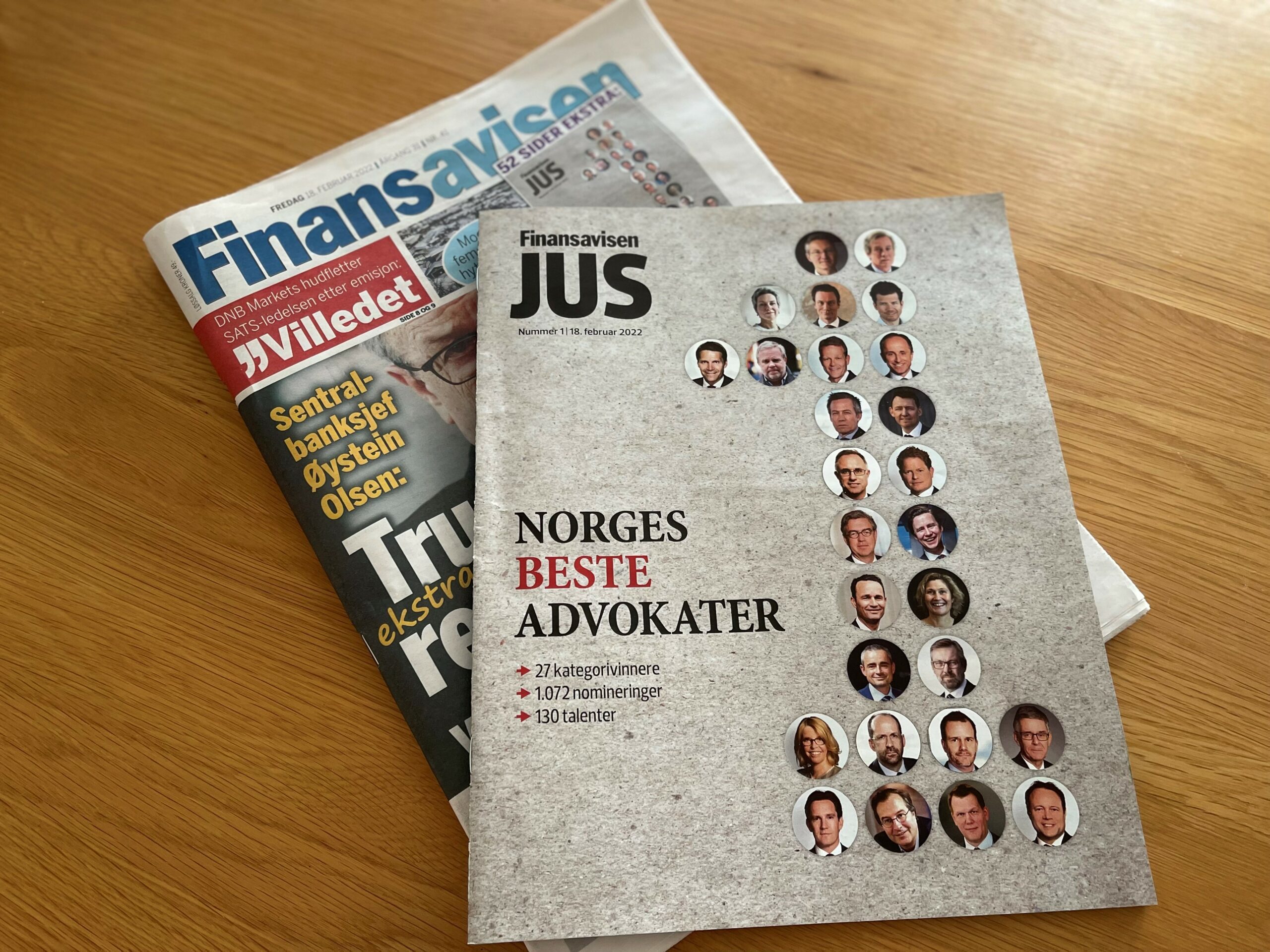
In this year’s survey conducted by the Norwegian Financial Newspaper, Brækhus lawyers are recognised as leading specialists in technology and digitalisation, international matters, IP and retail, as well as restructuring and insolvency. 

– It is great to see our lawyers highlighted among Norway’s foremost in areas that are strategically important to our business. We are dedicated to building market-leading expertise, particularly within technology and digitalisation, and international matters. These rankings affirm our achievements, says managing partner Atle H. Carlsen

Christoph Morck is ranked as the country’s seventh leading international lawyer, while Stein E. Hove is ranked fifth on the list of the country’s best lawyers in technology and digitalisation. 

Julius Berg Kaasin achieves two placements in this year’s survey. He is ranked tenth among the country’s leading lawyers in IP and seventh in retail. Audun Kleppestø is ranked fourth among the country’s promising talents in restructuring and bankruptcy. 

Brækhus assisted Swiss Diabetes Fund with its investment in Glucoset

Brækhus assisted Swiss Diabetes Fund with its investment in Glucoset

Brækhus assisted Swiss Diabetes Venture Fund in connection with its investment in Glucoset, a Norway-based company specializing in glucose monitoring solutions for intensive care units.

Brækhus assisted Swiss Diabetes Venture Fund in connection with its investment in Glucoset, a Norway-based company specializing in glucose montitoring solutions for intensive care units.

Brækhus assisted Swiss Diabetes Venture Fund throughout the acquisition process, handling legal due diligence and SPA, along with a technical IP due diligence in collaboration with Onsagers.

Brækhus’ team was headed by Christoph Morck and Julius Kaasin.

The investment is mentioned in Finansavisen on November 24, 2023 (in Norwegian).

Swiss Diabetes Venture Fund is a Switzerland-based fund primarily focused on investing in health technology within the diabetes sector.

Contact

Christoph Morck
Partner
Commercial Contracts, Company Law, Construction, Defence, security and preparedness, M&A

Julius Berg Kaasin
Partner
Artificial Intelligence (AI), Brækhus IP, Brækhus IP, Commercial Contracts, Dispute Resolution, Intellectual Property and Marketing Law, Media Law, Retail Law, Technology, Innovation and Digitalisation

Our lawyers have been recognised in Legal 500 2023

Our lawyers have been recognised in Legal 500 2023

Our lawyers have been recognised in the 2023 edition of Legal 500, a comprehensive global guide to law firms. Each year, Legal 500 evaluates and ranks law firms worldwide based on client feedback and market research. In this year’s edition, Brækhus has been ranked as a Leading Firm.

15 of our lawyers across 6 practice areas have been acknowledged in this year’s edition of Legal 500. Associate Partner Alexander Mollan has been named ‘Next Generation Partner’ for his expertise in the TMT (Technology, Media, and Telecommunications) practice area.

The recognized practice areas are fundamental to Brækhus’ core business, and we take great pride in being highlighted by Legal 500 for our strong expertise in these areas.

Our firm has been ranked in the following practice areas:

What our clients say about us:

Quick response rate. Clear recommendations. Efficient use of resources. Close follow-up.

Very diverse and competent team with international knowledge and a very service-minded approach.

Takes a holistic approach, and guides on commercial aspects to make sure nothing falls between the cracks.

No fuss, straight to the point. Great people to work with. Delivers results.

Brækhus lawyers get recognition in 8 categories in the Annual Lawyer Survey

Brækhus lawyers get recognition in 8 categories in the Annual Lawyer Survey

For the 25th year in a row, Kapital’s lawyer survey acknowledges the leading Norwegian lawyers and firms in a number of categories, and Brækhus’ lawyers are recognised as some of the country’s leading lawyers in their field of expertise.

Christoph Morck is ranked as the country’s sixth leading International Lawyer. Stein E. Hove is ranked number nine on the list of the country’s best lawyers within Technology and Digitalisation, and Christian Bendiksen is ranked fourth on the list of “Promising Talents” in the same category. Frank C. Aase ranks tenth on the list of the country’s leading lawyers within Restructuring and Insolvency, and he also ranks 1st on the list of the country’s most “Promising Talents” within Banking and Finance.
 
Just like Frank C. Aase, Julius Berg Kaasin receives acknowledgments in two categories in Kapital’s Annual Lawyer Survey. He ranks 1st as the country’s most “Promising Talent” within Retail Law, and he also ranks second on the list of “Promising Talents” within Intellectual Property. Audun Kleppestø ranks fourth on the list of the country’s most “Promising Talents” within Restructuring and Insolvency.
 
– It’s both inspiring and fantastic to see that our expertise is recognized by the industry! We are proud of our rankings and the fact that we continue to build strong teams within Banking & Finance, Restructuring & Insolvency, Technology & Digitalisation, Retail Law, Intellectual Property, and in addition to a strong international focus, says the chairman of the board in Brækhus, Christoph Morck.

Legal 500 recognises Brækhus as Leading Firm

Legal 500 recognises Brækhus as Leading Firm

Each year, the leading ranking firm Legal 500 assesses and recommends law firms around the world. All rankings are based on feedback from clients and market insights. In this year’s ranking, Brækhus is once again ranked ‘Leading Firm’.

15 of Brækhus’ lawyers from five different practice areas are recommended in the 2021 edition of the Legal 500 ranking. This year, Senior Lawyer Alexander Mollan is ranked as ‘Rising Star’ for his expertise within TMT (Technology, Media and Telecommunications). We are pleased to see that the practice areas Brækhus is recommended for, are core areas of our business where we have specialist competencies.

Senior Lawyer Alexander Mollan is ranked as ‘Rising Star’ by The Legal 500 for his expertise in Technology, Media, and Telecommunications.

What our clients say about us:

Brækhus Advokatfirma is professional with dedicated advocates of the highest standards.

The Brækhus team is always one step ahead, ready to support their clients. Their advice is always provided in a context that makes it obvious they have deep insights into their clients’ needs.

Very strong at understanding our business as a client. Proactive and seeking closure.

Read more about the rankings on Legal500.com

Finansavisen’s annual lawyer survey ranks several of Brækhus’ lawyers as leading experts in their field

Finansavisen’s annual lawyer survey ranks several of Brækhus’ lawyers as leading experts in their field

For the 24th year in a row, Finansavisen’s lawyer survey acknowledges the leading Norwegian lawyers and firms in a number of categories, and Brækhus’ lawyers are recognised as some of the country’s leading lawyers in their field of expertise.

Stein E. Hove is ranked as number ten on the list of the country’s leading lawyers within Technology and Digitalisation and Christian Bendiksen as fifth on the list of “Promising Talents” within the same category. Christoph Morck, who primarily works with cross-border M&A, company law, and construction, is member of the international Board of Directors at the premier global legal network Meritas. Christoph is ranked as number five in the category of Norway’s leading international lawyers.

Brækhus tops several of the lists among this year’s “Promising Talents”. Marcus Lindstrøm is recognised as leading within Construction, and Julius Berg Kaasin is recognised as leading within Trade and fourth within IP. Frank C. Aase is recognised as leading within two categories, Banking and Finance, and Restructuring and Insolvency.

Managing Partner Frank C. Aase.

“It is fantastic to see that our lawyers are recognised amongst the country’s most competent lawyers within their field of expertise. Brækhus has strong competencies within construction, banking and finance, restructuring and insolvency, technology and digitalisation, trade and IP, in addition to a solid international presence. The survey confirms our strengths, which is the result of long-term and targeted teamwork” says Managing Partner Frank C. Aase.

Christoph Morck elected as member of the international Board of Directors at Meritas

Christoph Morck elected as member of the international Board of Directors at Meritas

We are pleased to announce that Christoph Morck, Chairman of the Board at Brækhus law firm, has been elected as member of the international Board of Directors at Meritas. After an initial interim period until April next year, Morck will be able to serve on the Membership Committee for a period of additional three years.

“It is a great honor to be put forward for the position and I look forward to working even closer with Meritas, Chair Jill D. Wiley and the rest of the Board to further develop the international cooperation amongst the Meritas member firms. Continuous cross-border and international cooperation and mindset is of crucial importance in these challenging times” says Christoph Morck.

Morck has been a partner at Brækhus since 2016 and heads the firm’s Corporate / M&A department. He is dual qualified, as being admitted to the Bar in Norway and licensed to practice law in Germany. Morck advises international and foreign companies with their establishment and cross border activities in Norway, and Norwegian companies doing business abroad. He is recommended by Legal 500 and receives excellent feedback from clients: ‘Christoph Morck is the star of Brækhus. He is very knowledgeable about domestic law and brings an international value proposition to the table.‘

Brækhus is a Norwegian law firm with a strong focus on cross-border and international matter and advises it’s clients on all business matters ranging from general legal advice to complex transactions and disputes. Brækhus is committed to meeting the markets’ changing demand for smarter and more efficient deliveries of legal services. The firms’ goal is to help clients reach their goals. Brækhus is proud of being an active member in the Meritas network.

Founded in 1990, Meritas is the premier global alliance of independent law firms. Their market-leading member firms offer a full range of legal services, enabling clients to do business anywhere. Meritas is ranked in Chambers & Partners as Band 1 – Leading Law Firm Networks: The Elite.

For more information please contact Christoph Morck, Partner, E: morck@braekhus.dev11.dekodes.no, T: (+47) 452 18 904